

Faster Grades, Fewer Handoffs: How SIS Integration Supports Modern Law School Workflows
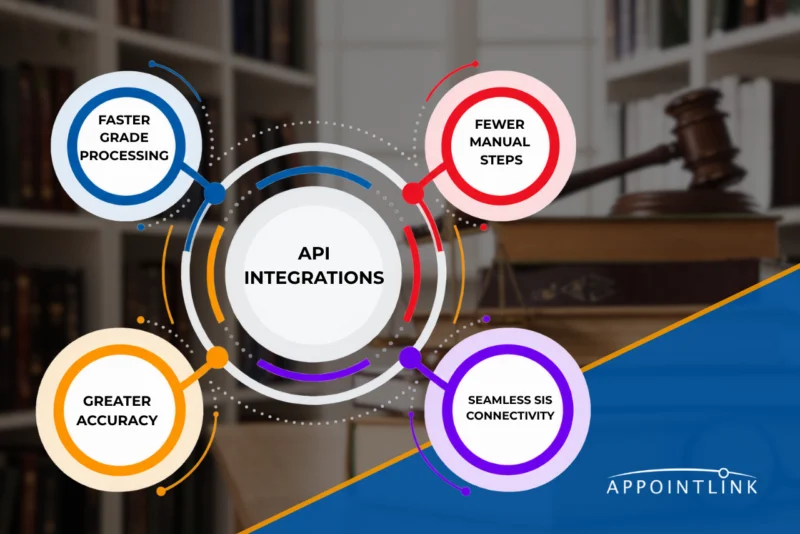
When a law school considers a new grading, exam scheduling or take-home exam solution, one of the first questions is often the most important:
“How will this connect to our existing data and systems?”
It’s a fair question. Law schools already depend on student information systems (SIS) such as Banner, Colleague, Workday and others to manage essential academic records. Those systems are central to the institution, and any outside platform that supports grading or exam administration must be able to work with them reliably.
At AppointLink, we understand that concern. Schools aren’t simply asking whether an integration is technically possible. They’re asking whether it will be difficult, disruptive or risky. They want to know how quickly data can move, how much work implementation will require and whether the partner they choose has already solved similar challenges for other institutions.
That’s why AppointLink has continued to invest in direct integration capabilities, including work with Ellucian Ethos for Banner and Colleague environments, along with parallel integration work supporting other major SIS platforms like Workday. These capabilities are part of a larger effort to help law schools modernize critical academic workflows without creating unnecessary burden for registrars, faculty, academic deans or IT teams.
The problem with the old way
For years, many schools have relied on manual or semi-manual processes to move academic data between systems. Enrollment data may be exported into files, reformatted, sent through secure transfer methods, uploaded elsewhere and later checked by another person. Grade output may follow a similar path in reverse.
In some environments, these steps are highly organized. In others, they depend on people remembering the right process at the right time, often under significant pressure. Either way, each handoff adds time and creates another opportunity for delay, error or exposure.
The true cost of this work is often underestimated because it’s spread across multiple people and departments. It may not appear as one large line item on a budget, but it still consumes time from registrars, IT staff, faculty support teams and administrators.
What direct integration changes
When AppointLink’s grading, exam scheduling or take-home exam tools are implemented, they require accurate enrollment data. The most reliable source for that information is typically the school’s SIS.
There are several ways to get that data. A school can send files, rely on reports or use a learning management system (LMS) as an intermediary. Those approaches may work in some cases, but each adds another step between the school’s SIS and the academic workflow the data is meant to support.
A direct integration allows AppointLink to connect more closely with the system where the data already lives. That means the process can happen more frequently, more securely and with fewer manual steps.
For grading, the impact can be significant. Instead of waiting for an overnight batch process, a registrar may be able to send grades back in seconds. If one late course needs to be finalized quickly, the team doesn’t have to wait until the next morning to know whether everything processed correctly. They can act, confirm and move forward.
That speed is not just a convenience. In law schools, timing can affect students directly.
Grades often play a role in interview opportunities, recruiting timelines and other academic milestones. If one school can finalize grades quickly while another is waiting on delayed processes, students may feel the difference. A slow workflow can create pressure for the registrar’s office, the dean’s office, faculty and students at the same time.
Reducing risk while improving accountability
Manual processes can also make it harder to pinpoint where something went wrong.
If a grade is entered incorrectly after data has passed through several people, files and systems, responsibility can become unclear. Was the issue in the file? The upload? The manual entry? The registrar’s process? The faculty member’s submission?
A more direct workflow makes the process easier to audit. It reduces unnecessary movement of data and helps clarify where responsibility belongs. If a faculty member enters a grade, that action can be tied more directly to the faculty member’s role in the process. That matters for accountability, review and institutional confidence.
A more resilient grading workflow
Many schools are also modernizing the systems that support academic operations. Some are moving from on-premise systems to Software as a Service (SaaS) environments. Others are evaluating new SIS platforms or changing how systems communicate with each other. But API integration is not limited to schools that have already moved to SaaS. In many cases, schools already have IT pathways in place that allow outside vendors to connect with institutional systems in a secure and structured way.
That can be an important advantage. When those pathways already exist, schools may be able to reduce the time, cost, and internal effort required to support a new integration. Instead of building a custom workaround from the ground up, IT teams can work through established processes designed for vendor connections.
The need becomes even more important when critical workflows depend on multiple systems or manual workarounds. If a grading process relies too heavily on an LMS, file exchange or staff intervention, a disruption in one place can create problems somewhere else.
Direct SIS integration helps reduce that dependency by allowing AppointLink to support grading and exam workflows closer to the source of the data. The impact is felt most at the pressure-filled points of the academic term, when grades are due, students are waiting and administrators need confidence that the process will work the way it should.
AppointLink’s role as an integration partner
AppointLink is an Ellucian integration partner, which gives our team access to technical resources, documentation and support that help us work effectively with Banner and Colleague environments. Successful integration requires understanding how systems are configured, how schools operate and how to resolve questions quickly when they arise.
Law schools don’t need a vendor that simply hands over software and leaves the rest to the institution. They need a partner who understands their workflows, their pressure points and their need for confidence during implementation.
Banner, Colleague, Workday and other systems are built to manage institutional academic data, and they do that job well. AppointLink adds value by supporting the specialized workflows law schools manage every term, helping grading, exam scheduling and take-home exam processes run more smoothly.
What schools should take away
When a law school evaluates grading and exam scheduling solutions, the question should not be limited to whether the software has the right features. The real question is whether the platform can fit into the school’s existing data environment in a way that improves the work.
- Can it reduce manual steps?
- Can it improve timing?
- Can it support accuracy?
- Can it work with integration pathways your IT team may already have in place?
- Can it help IT teams manage modernization?
- Can it give registrars, deans and faculty more confidence during critical academic cycles?
For AppointLink, integration isn’t just a technical consideration. It’s part of helping law schools reduce manual work, protect the accuracy of academic records and give the people responsible for grading and exam administration more confidence when the pressure is highest.
And ultimately, it helps schools serve students more effectively.
Interested in learning how AppointLink can connect with your school’s SIS? Request a demo or contact our team to discuss your grading workflow, integration needs and implementation path.